


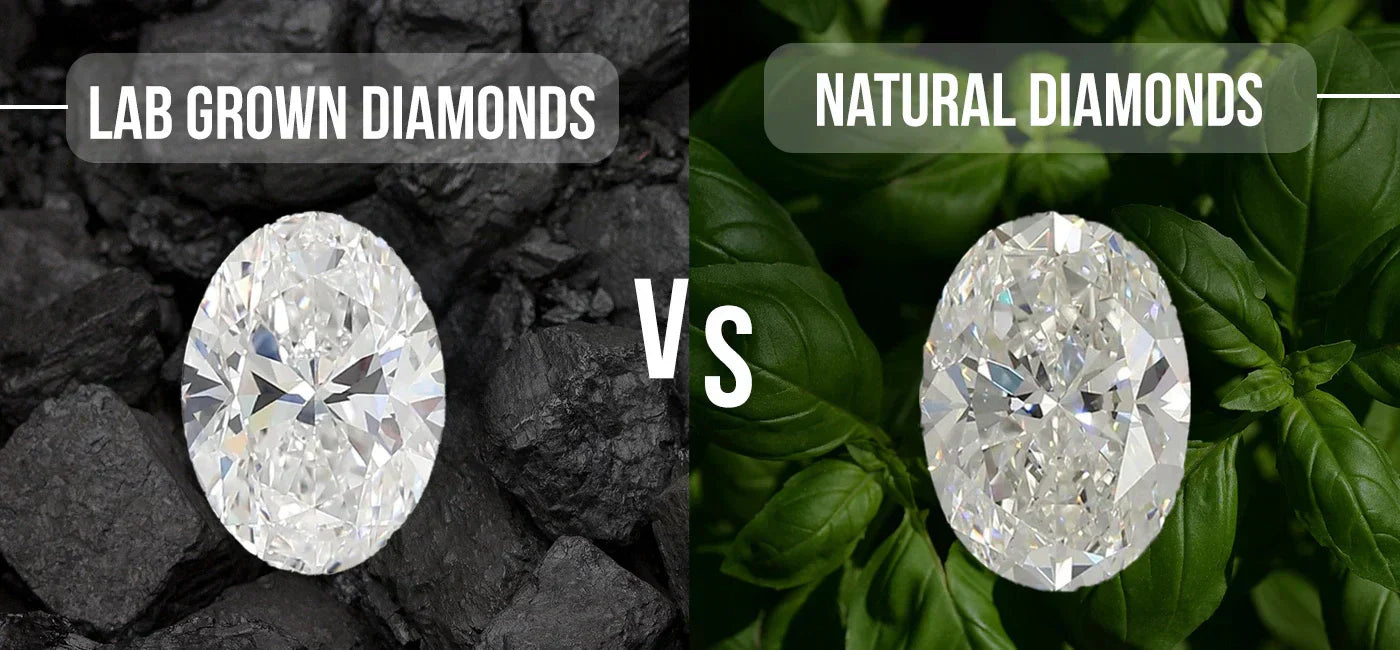
Have you ever wondered why some diamonds cost a fortune while others are much more affordable, even though they look exactly the same? The secret lies in where they come from.
Today, we're breaking it all down in the simplest way possible. No confusing terms. No fancy jargon. Just the real story behind two kinds of diamonds that are taking the jewelry world by storm.
First, What Even Is a Diamond?
A diamond is made of carbon — yes, the same element found in your pencil! When carbon gets squeezed under extremely high heat and pressure, its atoms lock together in a super-tight pattern. The result is the hardest natural material on Earth, a diamond.
Here's the fun part: both lab-grown and natural diamonds are made of carbon. Both are 100% real diamonds. The only difference is where and how they were created.
Natural Diamonds: A Gift from the Earth
Natural diamonds are formed about 100 miles beneath the Earth's surface, where temperatures reach over 2,000°F. The Earth slowly squeezes carbon under enormous pressure for billions of years until a diamond is born. Then, volcanic activity pushes these diamonds closer to the surface, where miners carefully extract them.
Think of a natural diamond as a treasure the planet has been hiding since before the dinosaurs walked the Earth. Some natural diamonds are over 3 billion years old. That's older than most life on this planet.
That deep history is a big reason why people feel so emotionally connected to natural diamonds. When you wear one, you're literally wearing a piece of Earth's ancient story.
Lab Grown Diamonds: Made by Science
Lab grown diamonds are created by scientists in controlled laboratory environments. Using advanced machines, they replicate the exact same conditions that exist deep inside the Earth — extreme heat and extreme pressure — but in a fraction of the time.
Instead of billions of years, it takes just a few weeks.
There are two main methods used. One is called High Pressure High Temperature (HPHT), which mimics how the Earth grows diamonds naturally. The other is called Chemical Vapor Deposition (CVD), where a special gas slowly builds a diamond layer by layer, almost like 3D printing, but with carbon atoms.
The result is a diamond that looks, feels, and sparkles exactly the same as one pulled from the ground.
So What's Actually Different Between Them?
The biggest differences come down to origin, price, and rarity.
Natural diamonds are rare. It took the Earth billions of years to make them, and there's a limited supply. That rarity drives the price up. They also carry a strong emotional and historical value that many people cherish.
Lab grown diamonds are not rare in the same way. Since they can be produced on demand, they are much more affordable — typically 50% to 70% cheaper than a natural diamond of the same size and quality. That means you can get a much bigger, more stunning diamond for the same budget.
In terms of looks and chemistry, there is zero difference. Even an expert gemologist cannot tell them apart with the naked eye. The only way to distinguish them is with a special scientific machine that detects tiny differences in how they were formed. Both come with proper certification from recognized gem labs.
Which One Is Better?
Honestly? Neither is "better." It depends on what matters to you.
If you value deep history, rarity, and the romance of wearing something the Earth created billions of years ago, a natural diamond is your perfect match. It also tends to hold its resale value better over time.
If you want a larger, equally beautiful diamond at a much lower price — and you love the idea of a more eco-friendly choice that doesn't require mining — then a lab grown diamond is a brilliant option.
Both are real. Both are stunning. Both will make someone's eyes light up.
The Bright Brilliance Take
At Bright Brilliance, we believe every diamond has a story worth telling. Whether yours was born in the heart of the Earth a billion years ago or carefully grown in a lab last month, it is a symbol of something real and beautiful.
The best diamond is not the most expensive one. It's the one that feels right for your story, your values, and your budget.
And whichever you choose, it will shine just as bright.


