


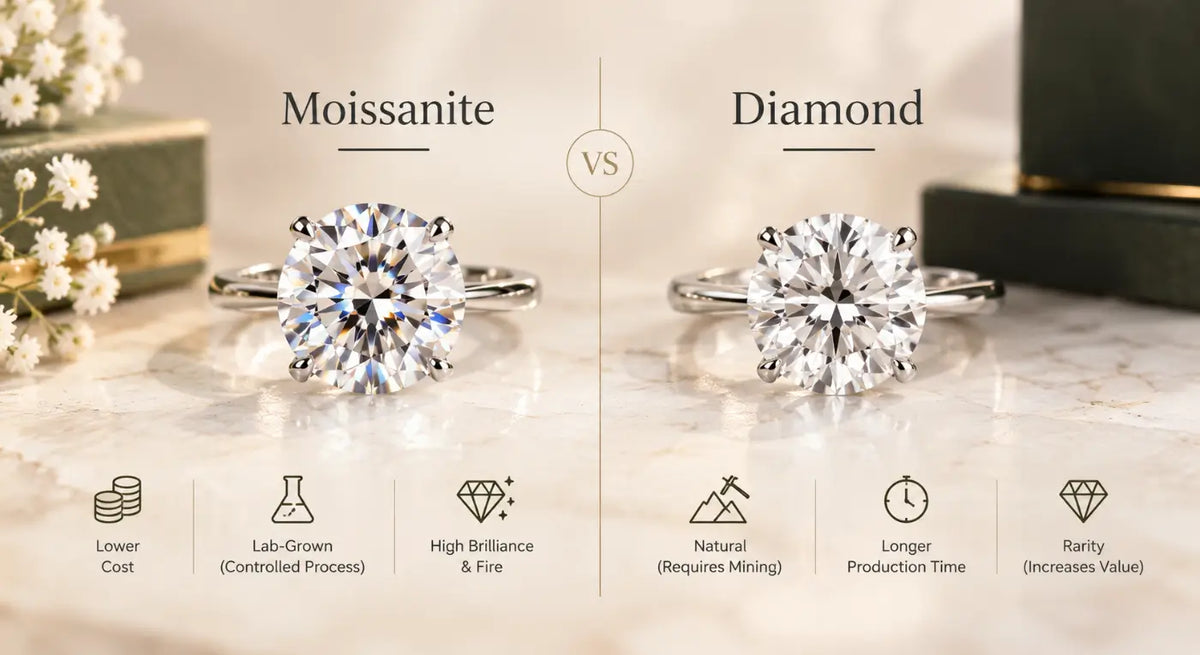
You've probably seen it before. Two rings sit side by side, both sparkle like crazy, and one costs a fraction of the other. So what's the catch? Is moissanite a "lesser" stone, or is there something hidden in the fine print?
Here's the honest answer: there's no catch. The reason moissanite costs less than diamonds comes down to how the stones are made, how rare they are, and how the diamond industry sets its prices. In this guide, we'll walk through exactly why moissanite is cheaper than diamond, what you do (and don't) give up, and how to decide which stone fits your love story and your budget.
What Is Moissanite?
Moissanite is a gemstone made of silicon carbide. It was first discovered in 1893 by French scientist Henri Moissan, who found tiny crystals of it in a meteor crater in Arizona. Natural moissanite is incredibly rare, so rare that you will never find it in a jewelry store.
Every moissanite stone in an engagement ring today is created in a lab. Scientists grow silicon carbide crystals under controlled heat and pressure, then cut and polish them into brilliant, sparkly gems. The result is a real, durable, beautiful stone, just not one pulled from the earth.
That lab-grown origin is the first clue to the price gap, and it's a big one.
Reason 1: Moissanite Is Grown in a Lab, Not Mined
Mining a natural diamond is a huge operation. Companies have to find deposits, move massive amounts of earth, and process tons of rock just to recover a small number of gem-quality stones. It takes heavy machinery, big crews, and years of investment. All of those costs get baked into the price you pay at the jewelry counter.
Moissanite skips all of that. Because it's created in a controlled lab environment, producers can plan their output, repeat the process, and scale up when demand grows. There's no digging, no guessing whether a deposit will pay off, and far less waste. Lower production costs mean a lower price tag for you, without changing what the stone is made of.
It's the same reason lab-grown diamonds are usually cheaper than natural ones. Controlled production is simply more efficient than extraction.
Reason 2: Diamond Prices Are Driven by Rarity and the 4Cs
A natural diamond's price depends heavily on the 4Cs: cut, color, clarity, and carat weight. A perfectly colorless, flawless stone is extremely hard to find in nature, so it commands a premium. Even a small step up in color or clarity grade can add hundreds or thousands of dollars.
Moissanite doesn't work that way. Because it's made in a lab, stones come out consistently clear and near-colorless, and there's no scarcity premium for a "perfect" one. Pricing is mostly based on size, cut quality, and color grade, which keeps things simple and predictable.
Then there's the carat factor. Diamond prices don't rise in a straight line; they jump sharply at popular sizes like 1 carat and 2 carats. Moissanite prices climb much more gently, so you can go bigger without the budget shock. A larger-looking stone for less money is one of the biggest reasons couples pick it.
Reason 3: The Diamond Supply Chain Adds Layers of Cost
A natural diamond often passes through many hands before it reaches you: the miner, the rough-diamond sorter, the cutter, the polisher, the grading lab, the wholesaler, and finally the retailer. Each step adds its own markup.
For years, a few large companies also influenced how much rough diamond reached the market. Controlling supply helps keep prices steady and high, which is a big part of why diamonds have long been seen as a luxury purchase.
Moissanite has a much shorter and simpler path. Fewer middlemen and a flexible supply mean fewer markups along the way, and that saving gets passed on to the buyer.
Reason 4: Brand Perception and Market Demand
Diamonds have been the "traditional" engagement stone for generations, backed by decades of marketing that tied them to romance, status, and forever. That cultural weight keeps demand and prices strong.
Moissanite is newer to the mainstream. It's growing fast, especially among younger buyers who care more about sparkle, value, and ethical sourcing than tradition. But because demand is still smaller, and because the stone isn't treated as a rare investment piece, the price stays lower. In short, you're paying for the stone, not the legend around it.
Moissanite vs Diamond Price: What's the Real Difference?
Exact numbers change with size, cut, and quality, but here's a rough idea. A one-carat-equivalent moissanite typically costs a few hundred dollars, while a natural diamond of similar size and quality can cost several thousand. Lab-grown diamonds usually sit in the middle.
| Stone Type | Origin | Typical Price |
|---|---|---|
| Moissanite Affordable alternative | Lab-Grown | Lowest |
| Lab-Grown Diamond Real diamond | Lab-Grown | Mid-Range |
| Natural Diamond Naturally formed | Mined | Highest |
Prices are general comparisons for similarly sized stones. Actual prices vary by cut, color, clarity, quality, and seller.
That gap can add up to thousands of dollars, which many couples put toward a bigger stone, a custom setting, a honeymoon, or a down payment on a home.
Does Cheaper Mean Lower Quality?
Not at all. Cheaper isn't the same as weaker or less beautiful. Here's how moissanite really performs:
-
Hardness: Moissanite scores around 9.25 on the Mohs scale, just below diamond's perfect 10. It resists scratches well and is great for everyday wear.
-
Sparkle: Moissanite has a higher refractive index than diamond, which gives it plenty of fire- those rainbow flashes you see in the light.
-
Clarity and color: Lab-grown stones are typically clean and near-colorless.
To be fair, there are trade-offs. Moissanite's sparkle looks different from a diamond's. It's more colorful, which some people love, and others find a bit too flashy compared to a diamond's classic white brilliance. Moissanite also generally has a lower resale value than a natural diamond. If you're buying a ring to wear and treasure, that matters less. If you're thinking of it as an investment, it's worth knowing upfront.
Who Should Choose Moissanite?
Moissanite is a great fit if you:
-
Want a bigger or better-looking stone on a fixed budget
-
Care about ethical, lab-grown sourcing
-
Love extra sparkle and fire
-
Would rather spend on design or experiences than on the stone alone
If a natural, mined diamond matters to you for tradition or sentiment, that's a perfectly valid choice too. The right stone is the one that feels right for you.
Final Thoughts
So, why does moissanite cost less than diamonds? Because it's made in a lab instead of mined, it doesn't carry a rarity premium, it moves through a shorter supply chain, and it doesn't ride on decades of diamond marketing. You get a durable, dazzling stone for far less.
At Bright Brilliance, you can explore moissanite and lab-grown diamond rings with a 30-day no-questions-asked refund and exchange, free resizing, and custom design options, so you can find (or create) the ring that's truly yours. Browse the collection today and see the sparkle for yourself.


